How do you know if your plant is getting too much light?
Choosing an Artificial Light Source
Different types of bulbs emit different types of light, a different spectrum of colors and varied intensities, meaning that not all of them are suitable for each type of plant. Knowing the specific light requirements for your indoor plants will benefit you when trying to determine what type of artificial light will aid your plants best.
For indoor plants that require only low levels of light or merely a little extra supplement, incandescent lamps are suitable. While the bulbs emit primarily red light, which only meet half of the plant’s needs, they will suffice if you only require a few hours of additional illumination.
Incandescent bulbs do, however, have the downside of burning hot, which reduces humidity and creates a dry environment for plants, potentially burning their leaves. It is vital you take this into account and make allowances when setting up incandescent lamps.
Regular fluorescent bulbs provide a cooler environment for plants while producing up to three times more light than an incandescent bulb of the same wattage. They primarily produce blue light, which on its own cannot sustain plants. To combat this, consider using a two-bulb fixture that allows you to combine the light from both fluorescent and incandescent lights to create a full spectrum of color.
Perhaps a better alternative for promoting the healthy growth of indoor plants is a full-spectrum fluorescent grow light. They’re designed specifically for this use and come with all the advantages of regular fluorescent bulbs, along with a few of their own. Full spectrum fluorescent grow bulbs mimic sunlight and are calibrated to replicate approximately 94% of the light spectrum, making them a highly suitable choice for illuminating indoor plants.
If you need to illuminate a large area, you might consider using metal-halide (MH) and HPS lamps. These lights provide the best spectrum of colors for aiding plant growth. They emit a strong white glow, which is not always suitable for standard homes.
At home, a concealed area is recommended for optimal performance of these lights, but they are a top choice for bringing artificial light to indoor farms and other industrial endeavors.
LED grow lights also provide a sufficient amount of red and blue to indoor plants, without the strong white glow and without the danger of overheating. The technology is relatively new, with many growers praising its effectiveness.
Our Too-High Amount of Light
In this last grow while the plants were flowering, I lowered the temperature in my grow tent with an AC so I could get my grow light closer. I also used a fan to blow air right under the light to further reduce the amount of heat on the plants. Generally a 600W HPS grow light should be kept ~16″ away from the tops of the plants in order to give the same brightness level as direct sunlight.
I ended up keeping my 600W light only 8 inches above my plants, but the heat was reduced enough that I could stick my hand right over the plants without my hand getting uncomfortably warm. I thought that the plants would be able to use all that extra light because they didn’t need to worry about heat.
When we measured the amount of light the plants were getting with a lux meter, we got readings between 105,000 and 110,000 lux! This means that these cannabis plants were getting more light than they would on a sunny desert day, but with temperatures in the 70s. We thought this would make the plant grow even faster and better than in the wild. However, even with the heat controlled, not only did we not get faster growth or bigger yields (the opposite actually), problems showed up…
Tip Burn, Nutrient Deficiencies & Dying Leaves
As your plant gets higher levels of light, it increases how much nutrients are being taken in by the roots. This is most true for growers using powder or liquid nutrients.
This is because cannabis plants drink more water when it’s sunny out. And taking in more water at the roots also causes the plant to take in more nutrients. In other words…
Cannabis plants take in more water and nutrients in bright light
Why? Photosynthesis (the process of making energy from light) causes the plant to lose extra water out of the leaves. As a plant evaporates water from the leaves, it creates negative pressure which sucks up water from the roots like a straw. This capillary action is how plants get water from the roots to the leaves. Though plants can also absorb nutrients through their leaves, cannabis plants generally get the majority of their nutrients during the process of taking water in through the roots.
So how much the plant drinks has a big effect on how much nutrients are being taken in.
Different types of bulbs emit different types of light, a different spectrum of colors and varied intensities, meaning that not all of them are suitable for each type of plant. Knowing the specific light requirements for your indoor plants will benefit you when trying to determine what type of artificial light will aid your plants best.
For indoor plants that require only low levels of light or merely a little extra supplement, incandescent lamps are suitable. While the bulbs emit primarily red light, which only meet half of the plant’s needs, they will suffice if you only require a few hours of additional illumination.
Incandescent bulbs do, however, have the downside of burning hot, which reduces humidity and creates a dry environment for plants, potentially burning their leaves. It is vital you take this into account and make allowances when setting up incandescent lamps.
Regular fluorescent bulbs provide a cooler environment for plants while producing up to three times more light than an incandescent bulb of the same wattage. They primarily produce blue light, which on its own cannot sustain plants. To combat this, consider using a two-bulb fixture that allows you to combine the light from both fluorescent and incandescent lights to create a full spectrum of color.
Perhaps a better alternative for promoting the healthy growth of indoor plants is a full-spectrum fluorescent grow light. They’re designed specifically for this use and come with all the advantages of regular fluorescent bulbs, along with a few of their own. Full spectrum fluorescent grow bulbs mimic sunlight and are calibrated to replicate approximately 94% of the light spectrum, making them a highly suitable choice for illuminating indoor plants.
If you need to illuminate a large area, you might consider using metal-halide (MH) and HPS lamps. These lights provide the best spectrum of colors for aiding plant growth. They emit a strong white glow, which is not always suitable for standard homes.
At home, a concealed area is recommended for optimal performance of these lights, but they are a top choice for bringing artificial light to indoor farms and other industrial endeavors.
LED grow lights also provide a sufficient amount of red and blue to indoor plants, without the strong white glow and without the danger of overheating. The technology is relatively new, with many growers praising its effectiveness.
Our Too-High Amount of Light
In this last grow while the plants were flowering, I lowered the temperature in my grow tent with an AC so I could get my grow light closer. I also used a fan to blow air right under the light to further reduce the amount of heat on the plants. Generally a 600W HPS grow light should be kept ~16″ away from the tops of the plants in order to give the same brightness level as direct sunlight.
I ended up keeping my 600W light only 8 inches above my plants, but the heat was reduced enough that I could stick my hand right over the plants without my hand getting uncomfortably warm. I thought that the plants would be able to use all that extra light because they didn’t need to worry about heat.
When we measured the amount of light the plants were getting with a lux meter, we got readings between 105,000 and 110,000 lux! This means that these cannabis plants were getting more light than they would on a sunny desert day, but with temperatures in the 70s. We thought this would make the plant grow even faster and better than in the wild. However, even with the heat controlled, not only did we not get faster growth or bigger yields (the opposite actually), problems showed up…
Tip Burn, Nutrient Deficiencies & Dying Leaves
As your plant gets higher levels of light, it increases how much nutrients are being taken in by the roots. This is most true for growers using powder or liquid nutrients.
This is because cannabis plants drink more water when it’s sunny out. And taking in more water at the roots also causes the plant to take in more nutrients. In other words…
Cannabis plants take in more water and nutrients in bright light
Why? Photosynthesis (the process of making energy from light) causes the plant to lose extra water out of the leaves. As a plant evaporates water from the leaves, it creates negative pressure which sucks up water from the roots like a straw. This capillary action is how plants get water from the roots to the leaves. Though plants can also absorb nutrients through their leaves, cannabis plants generally get the majority of their nutrients during the process of taking water in through the roots.
So how much the plant drinks has a big effect on how much nutrients are being taken in.
These nutrient burn symptoms are actually caused by the grow light being too close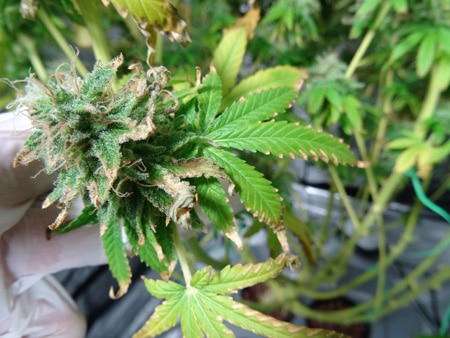


评论
发表评论